
Home & Kitchen · Buying Guide
How to Choose an Appliance Slider That Actually Fits
A countertop slider only helps if the appliance base fits the platform, the loaded weight stays within the tray limit, the added height still clears the cabinet above, and the appliance can pull forward far enough to operate safely. Start with those measurements—not the product name.
Disclosure: We may earn a commission from purchases made through links in this post, at no extra cost to you.
Quick Picks
Choose by the appliance footprint and clearance you actually have. These three options solve different fit problems rather than competing as one universal winner.
Best for a narrow appliance base

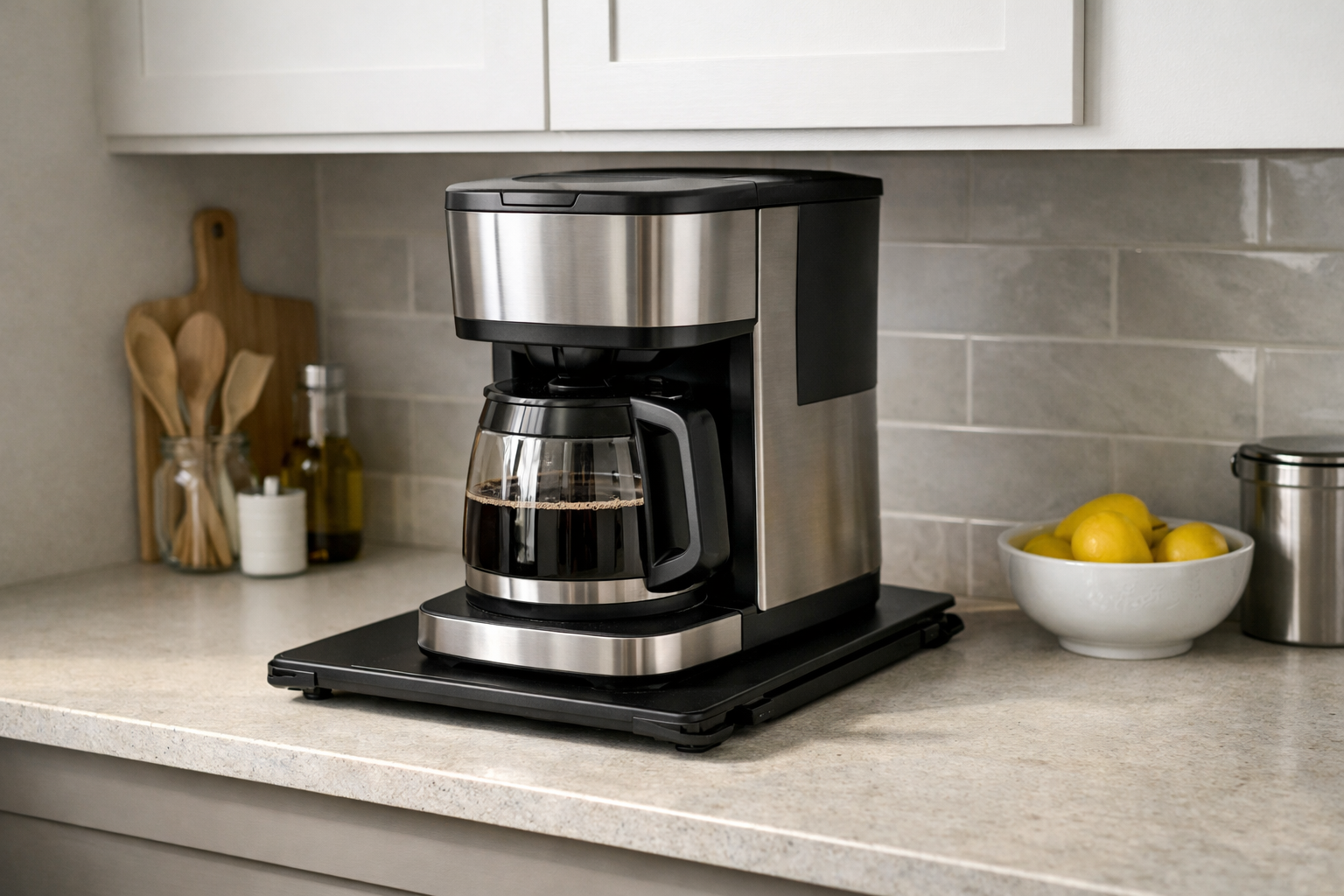
OXO Good Grips Countertop Appliance Slider
Model 13412400 measures 9 × 14 × 1.2 inches and is rated for 35 pounds. Its lever-controlled forward/back movement suits compact appliances when the extra 1.2 inches of height still fits beneath the cabinet.
Best for a deeper appliance base
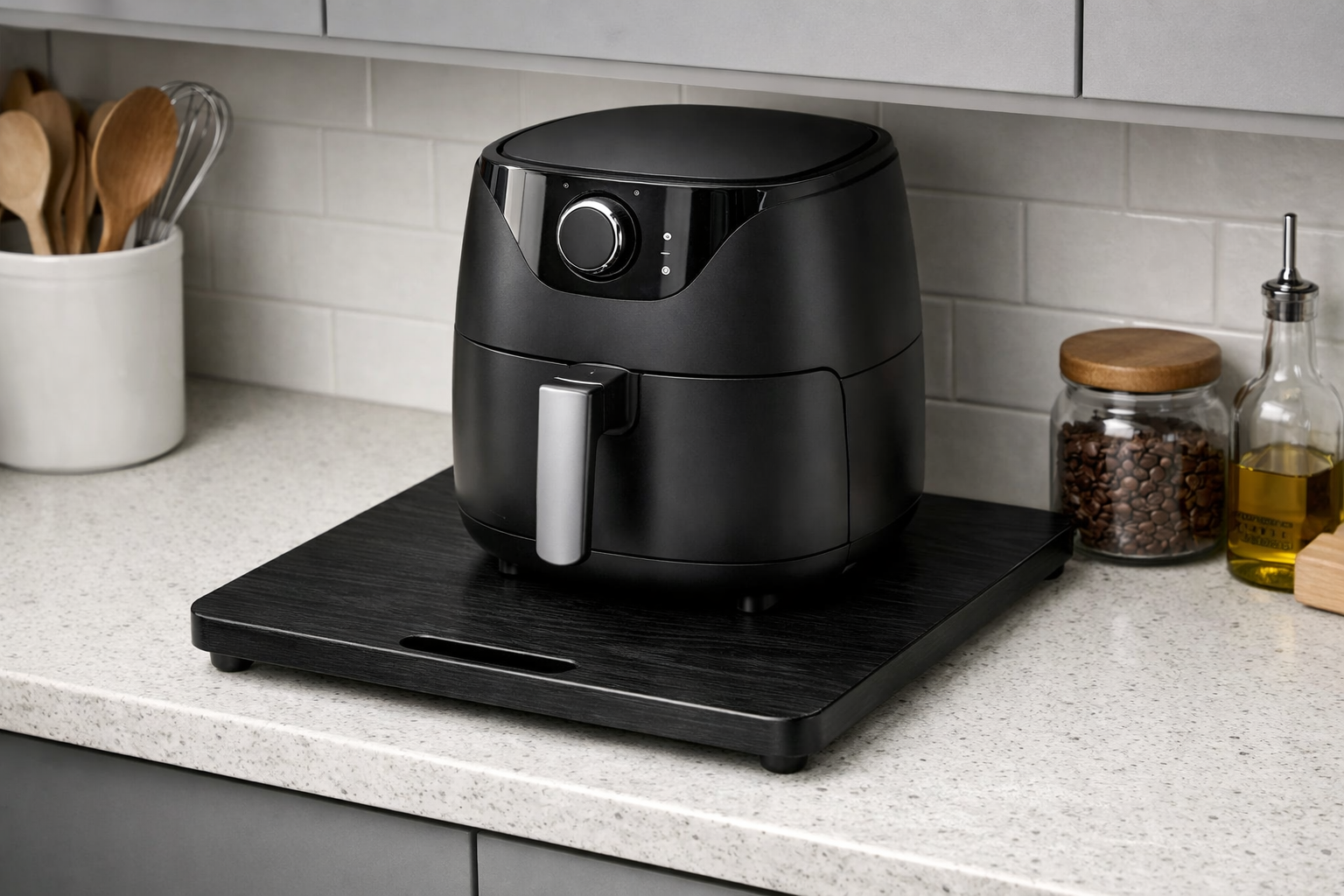
IBYX Appliance Sliding Tray
The black bamboo 12 × 16-inch variant is rated for 40 pounds, and IBYX currently lists an assembled height of 0.85 inch. It is useful when depth matters more than a narrow nine-inch platform.
Best for a wider, shallower appliance base

VEVOR Appliance Slider 10.5 × 13
The currently available black 10.5 × 13-inch variant is rated for a 40-pound maximum load. Its low-profile bamboo tray uses directional rubber wheels and a hollow pull handle, making it a useful match for wider but shallower appliance bases.
Measure the Appliance Before You Compare Sliders
The first number to record is the appliance’s contact footprint: the rectangle formed by every foot or part of the base that actually rests on the counter. Do not substitute the widest part of the appliance body for the support footprint.
Measure from the outer edge of the leftmost contact point to the outer edge of the rightmost, then from the frontmost point to the rearmost. For a reusable worksheet, use the Small Kitchen Measurement Checklist.

- Match both platform dimensions. The full contact footprint must fit within the usable width and depth.
- Use loaded operating weight. Add water, food, bowls, carafes, baskets or accessories that remain on the appliance while it moves.
- Add slider height. Compare appliance height plus tray height with the lowest cabinet rail, trim, light or outlet above it.
- Measure the parked depth. The slider must sit fully on the counter without projecting over the front edge.
- Measure forward travel. The appliance needs enough room to open, fill, remove or vent the parts you use during normal operation.
- Check movement direction and cord reach. Straight-travel sliders cannot replace a tray that needs to pivot or rotate.
Quick Comparison
| Best for | Product | Published size | Maximum load | Key constraint |
|---|---|---|---|---|
| Narrow appliance bases | OXO 13412400 | 9 W × 14 D × 1.2 H in | 35 lb | The 1.2-inch rise can matter under low cabinets |
| Deeper bases / more size choices | IBYX black bamboo 12 × 16 | 12 W × 16 D × 0.85 H in | 40 lb | Deeper platform with a verified low-profile assembled height |
| Wider, shallower appliance bases | VEVOR black 10.5 × 13 | 10.5 × 13 in; 0.7-in thick design | 40 lb | Directional rubber wheels move forward/back only |
OXO Good Grips Countertop Appliance Slider
Best for: a narrow appliance footprint when controlled forward-and-back movement matters
OXO model 13412400 measures 9 inches wide, 14 inches deep and 1.2 inches high. The published maximum load is 35 pounds. OXO describes a smooth glass platform, an easy-press lever and a gentle stop.
Why it works
The narrow nine-inch platform can work for compact coffee makers, blenders or espresso machines whose entire contact footprint fits inside that rectangle. The lever gives the user a clear way to release the tray before pulling it forward.
What to check
Add the full 1.2-inch slider height before deciding that an appliance will still fit beneath the cabinet. Also check the loaded weight, not only the empty appliance weight.
Skip it if
Your appliance feet need more than nine inches of support width, or your vertical clearance is already so tight that adding 1.2 inches creates a conflict.
IBYX Appliance Sliding Tray
Best for: a deeper appliance base or a shopper who needs more footprint choices
The black bamboo 12 × 16-inch variant measures 12 inches wide by 16 inches deep, is rated for 40 pounds, and IBYX currently lists an assembled height of 0.85 inch. IBYX also lists multiple platform sizes, which can help when a standard footprint does not match the appliance base.
Why it works
The 16-inch depth gives more support area for appliances whose feet extend farther from front to back. The broader size family also makes it easier to match the tray to the contact footprint rather than choosing one generic platform size.
What to check
IBYX currently states an assembled height of 0.85 inch. Add that height to the appliance before checking upper-cabinet clearance. Before buying, confirm that the Amazon listing is still the black 12 × 16-inch variant because marketplace options can change.
Skip it if
Your appliance contact footprint exceeds 12 × 16 inches, your layout requires the appliance to pivot rather than travel straight forward and back, or the extra 0.85 inch creates an upper-cabinet conflict.
VEVOR Appliance Slider 10.5 × 13
Best for: a wider, shallower appliance base when a low-profile tray and straight travel suit the counter
The currently available black VEVOR variant measures 10.5 × 13 inches, is made from bamboo, and is rated for a maximum load of 40 pounds. VEVOR describes a 0.7-inch-thick design, directional rubber wheels and a hollow pull handle.
Why it works
Its wider, shallower footprint solves a different fit problem from the narrow 9 × 14 OXO tray, while the low-profile design can help when upper-cabinet clearance is tight. The 40-pound load rating also gives more headroom than the OXO option.
What to check
The directional wheels are intended for straight forward-and-back movement rather than swiveling. Amazon currently labels this black variant as 10.5 inches deep by 13 inches wide; recheck the selected size and color on the listing before purchase because marketplace variants can change.
Skip it if
Your kitchen layout requires the appliance to rotate after pull-out, your contact footprint needs more than 10.5 inches of depth, or you need a deeper support platform such as the 12 × 16 IBYX option.
Storage Footprint Is Not the Same as Operating Footprint
A slider can solve the storage problem and still fail during actual use. The operating footprint includes the parked appliance, the distance the tray moves forward, and the extra room needed to open or remove whatever the appliance uses.
That can mean lid clearance, a rear water reservoir, a coffee carafe, an air-fryer basket, a mixer head, steam, exhaust or cord access. For heat- or steam-producing appliances, follow the appliance manual’s placement and clearance requirements; the slider itself does not establish a safe operating zone.
Common Fit Mistakes
- Measuring the outer appliance housing instead of its feet or contact base
- Checking platform width but forgetting platform depth
- Using empty appliance weight instead of loaded operating weight
- Ignoring the height added by the slider
- Measuring only the parked position and not the pull-forward operating zone
- Assuming directional wheels can swivel sideways
- Forgetting cord reach and outlet position
- Planning to pull the tray beyond the supporting countertop
Pre-Purchase Measurement Checklist
- Contact-footprint width: ______ inches
- Contact-footprint depth: ______ inches
- Loaded operating weight: ______ pounds
- Appliance height: ______ inches
- Slider height: ______ inches
- Combined height beneath cabinet: ______ inches
- Available parked counter depth: ______ inches
- Forward travel needed for normal use: ______ inches
- Required lid / basket / reservoir / head clearance checked: Yes / No
- Cord reaches safely through the full travel path: Yes / No
- Slider remains fully supported when extended: Yes / No
- Appliance manual placement and ventilation rules checked: Yes / No
Frequently Asked Questions
Should an appliance slider be larger than the appliance?
It needs to support the complete contact footprint formed by the appliance feet or base. The visible housing can be wider than that footprint, but every weight-bearing contact point should remain supported.
Can I use a slider under an air fryer or toaster oven?
Only when the appliance footprint, loaded weight and full operating position fit safely and the setup follows the appliance manufacturer’s heat, ventilation, placement and surface requirements.
How much upper-cabinet clearance do I need?
Add the slider’s overall height to the appliance height, then compare that total with the lowest cabinet rail, trim, light, outlet or other obstruction above the parked position.
Can an appliance slider turn sideways?
Not necessarily. Many models are designed for forward-and-back travel. If the appliance must rotate after pull-out, verify that movement before choosing the tray.
How We Researched
Good Things Atlas compared appliance sliders by the constraints that determine real fit first: usable platform dimensions, loaded weight, added height, travel direction, handle access and the operating space required after the appliance is pulled forward.
We reviewed current manufacturer and retailer information for platform dimensions, load ratings, added height, movement and availability, and matched those details to the exact product variants discussed in this guide. When a specification or listing could not be verified confidently, we excluded it rather than guessing. Read more about how we research product recommendations.