Home & Kitchen
An under-sink cabinet can look spacious right up until you try to put an organizer inside it.
The problem is rarely the cabinet’s advertised width. It is the drain pipe in the middle, the shutoff valve near the wall, a garbage disposal hanging below the sink, a hinge that projects into the opening, or a door that prevents a pull-out from traveling straight forward.
That is why the safest way to shop for an under-sink organizer is to map the obstructions first and choose the organizer second.
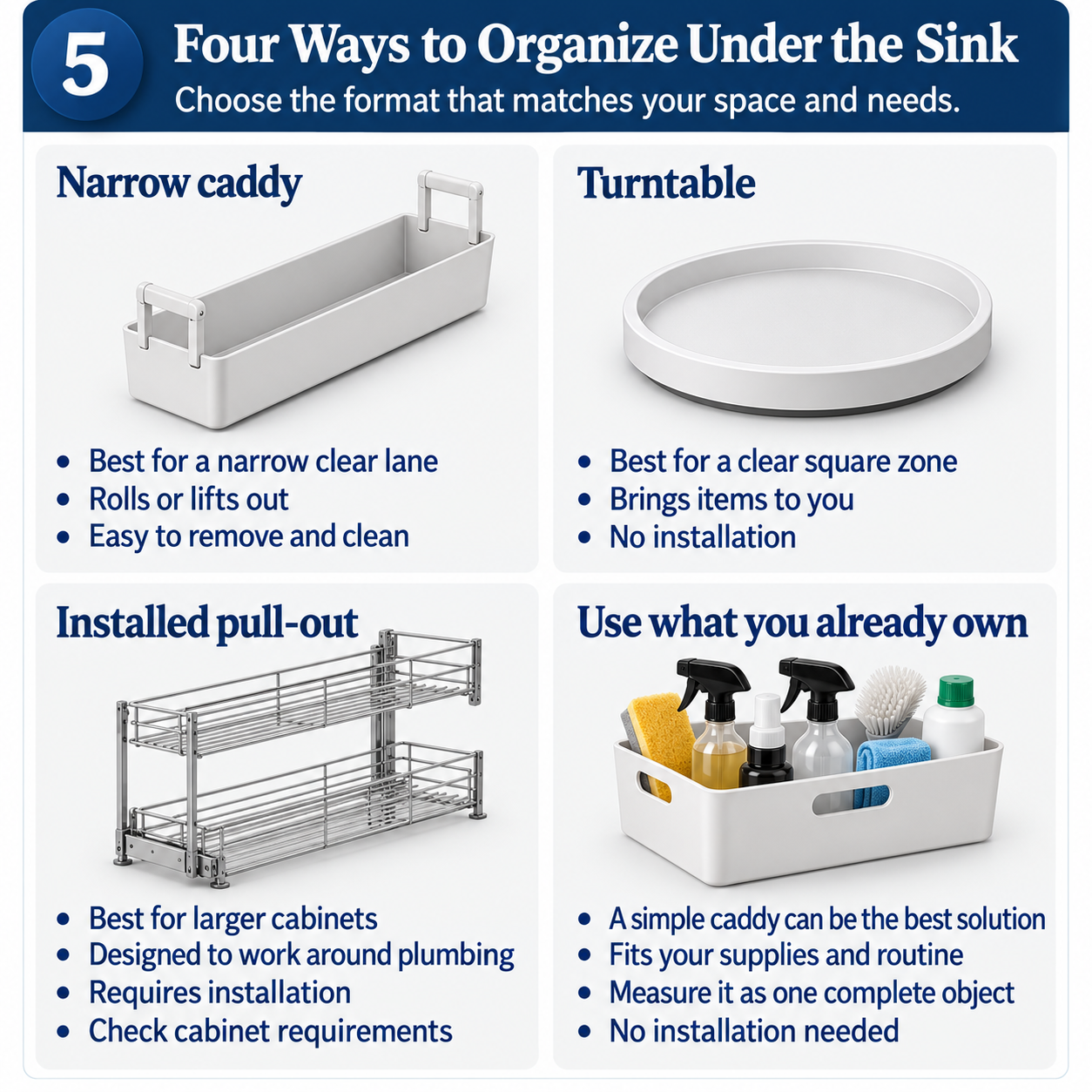
This guide shows how to measure the usable space, how to distinguish a product’s base footprint from the room it needs to operate, and when a narrow caddy, turntable, removable bin or installed pull-out makes sense.
You may discover that the best answer is an organizer you already own.
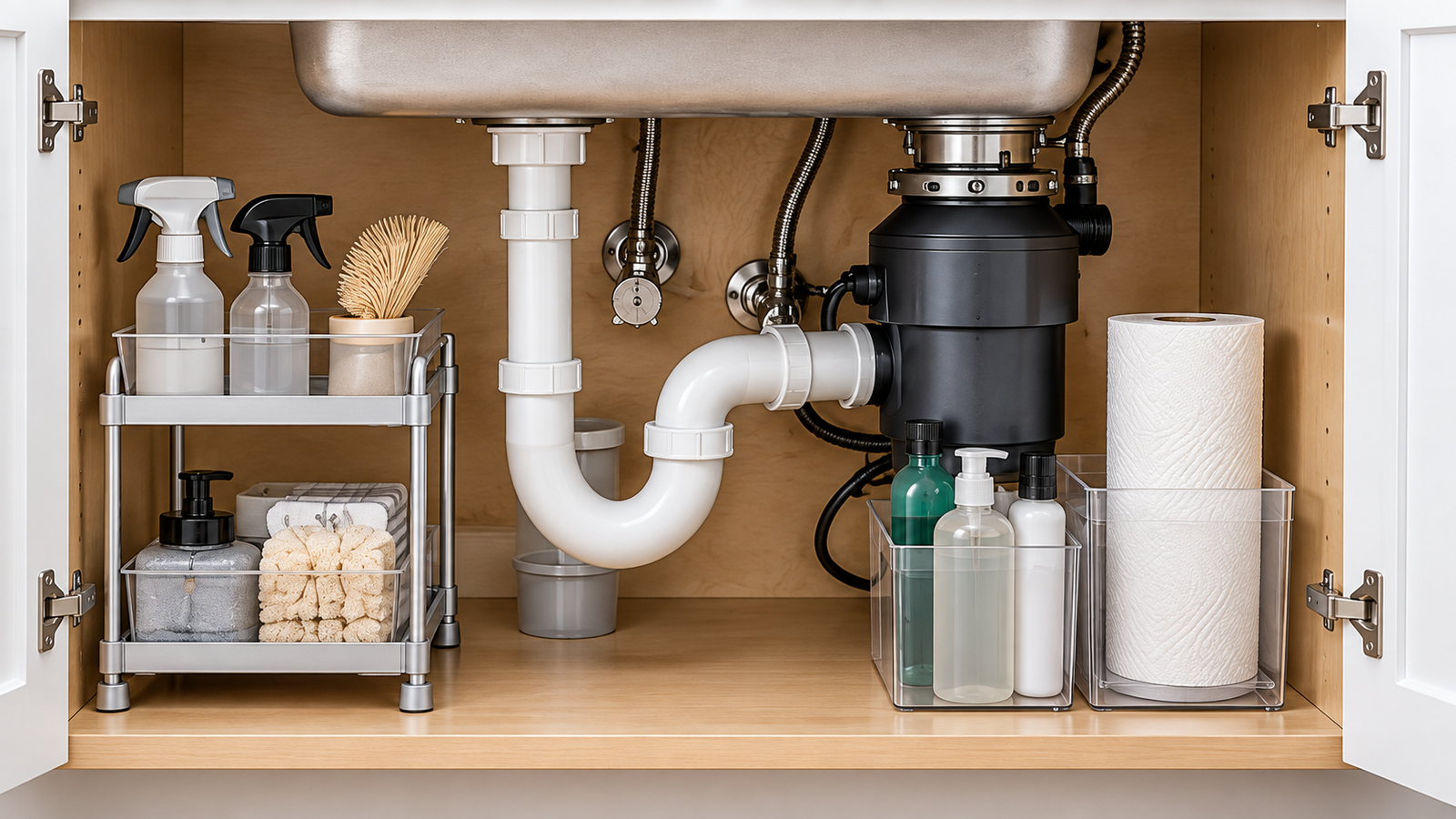
Jump to
Quick picks · Measure first · Recommendations · Layout options · FAQ
Quick decision guide
| Your cabinet has… | Start with… | Buy only if… | Main thing to check |
|---|---|---|---|
| One narrow clear lane beside the plumbing | Narrow removable or rolling caddy | The full caddy clears the opening and pipes | Width, depth and pull path |
| A clear square area | Turntable | Bottles can rotate without touching plumbing | Operating diameter, not just base size |
| A large stable cabinet with a clear installation zone | Installed pull-out | Mounting area and full travel path both work | Opening, floor, plumbing and extension |
| Irregular plumbing with little continuous space | Small removable bins/caddy you already own | A new product clearly improves access | Individual usable zones |
| A center stile or narrow doorway | Paper/cardboard template first | The product can physically enter the cabinet | Narrowest opening |
Do not start with the outside cabinet width
A nominal 30-inch or 36-inch sink cabinet does not give you 30 or 36 inches of usable organizer space.
Open both doors and look at the narrowest point an organizer has to pass through. A face frame, center stile or hinge can reduce the entry long before the organizer reaches the larger interior cavity.
Then look upward and backward.
The sink bowl may reduce height. A garbage disposal may occupy one side. The P-trap may block the center. Supply lines and shutoff valves can remove small but important sections near the back wall.
The usable cabinet is therefore not one rectangle. Think of it as several smaller zones.
Make an obstruction map
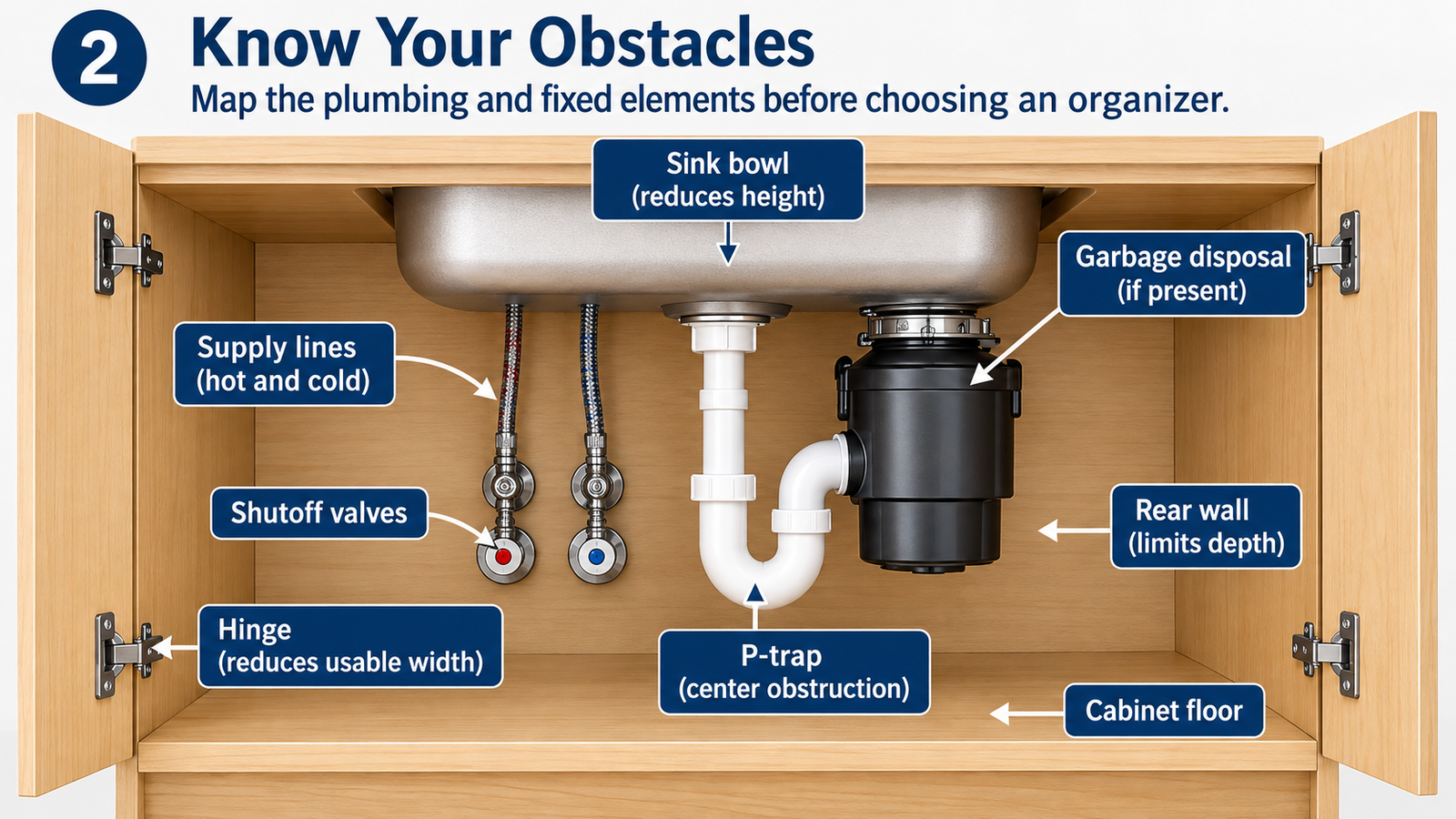
Empty the cabinet completely and take a photo from directly in front.
On paper, sketch the cabinet opening and mark anything you should not expect the organizer to occupy:
- drain and P-trap
- hot and cold supply lines
- shutoff valves
- garbage disposal, if present
- hoses or filters
- hinges
- center stile or face frame
- door hardware
- sink bowl above
- rear wall or other fixed obstruction
Do not move, bend or compress plumbing to make an organizer fit.
The purpose of the map is the opposite: find the space the plumbing already leaves available.
Take seven measurements
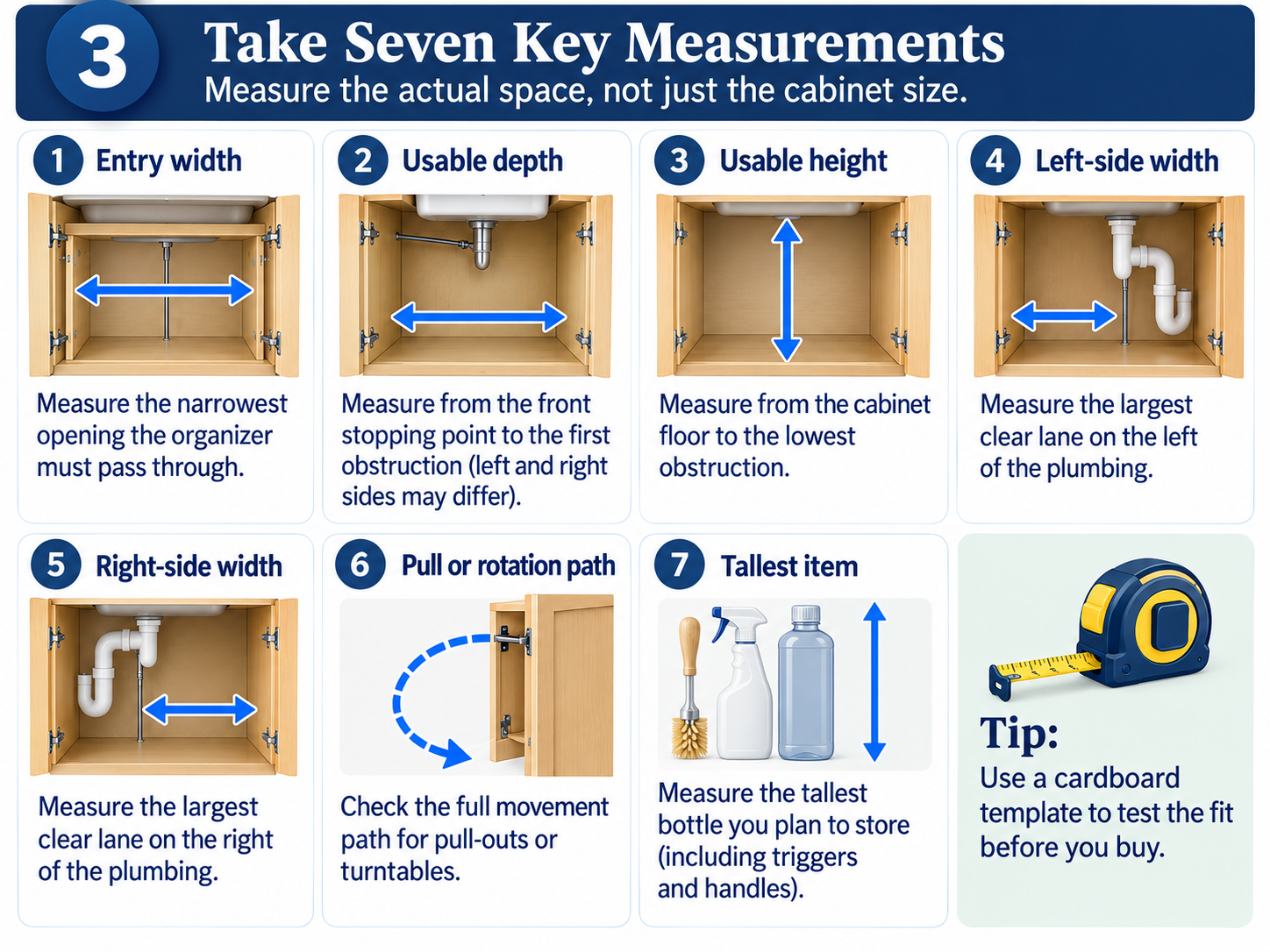
1. Narrowest entry width
Measure the actual opening the organizer must pass through, not merely wall-to-wall space inside the cabinet.
Check the opening at different heights if hinges or framing intrude.
2. Usable depth
Measure from the practical front stopping point to the first obstruction at the rear.
Do this separately on the left and right if plumbing creates unequal zones.
3. Lowest usable height
Measure from the cabinet floor to the lowest obstruction above the proposed organizer.
The underside of the sink, drain assembly and disposal can produce different heights across the same cabinet.
4. Left-side clear width
Measure the largest uninterrupted lane on the left of the plumbing.
5. Right-side clear width
Repeat on the right.
Do not assume both sides are equal.
6. Pull or rotation path
A product can fit while parked and still fail during use.
A pull-out needs room to travel through the doorway. A turntable needs enough surrounding clearance for the bottles or containers on top to rotate.
7. Tallest item you actually plan to store
The organizer frame is only part of the height calculation.
Measure spray triggers, pumps and handles too. A low tray that technically fits below a drain may become unusable once a tall bottle is loaded.
Base footprint is not the same as operating footprint
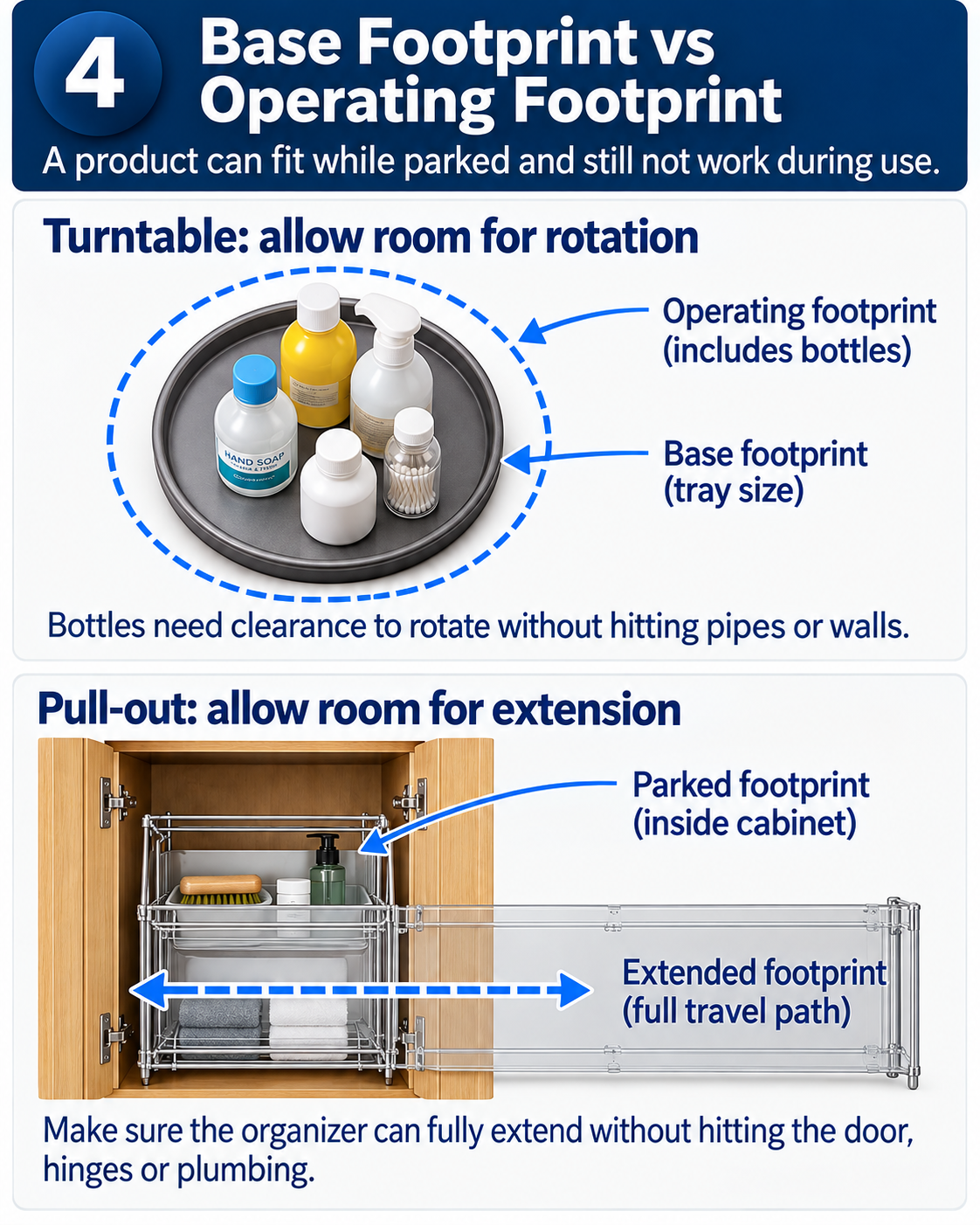
This is one of the easiest mistakes to make.
Suppose a turntable is 11 inches wide. The base may fit inside an 11-inch square zone, but a spray bottle near the edge can sweep through a larger circle as the tray turns.
The same principle applies to pull-outs.
A drawer can fit perfectly inside the cabinet but hit a door, hinge, adjacent handle or plumbing component while extending.
For anything that moves, measure where it goes, not just where it rests.
Three product formats worth considering
best for a narrow clear lane
YouCopia RollOut Under Sink Caddy, 8″
The YouCopia RollOut is useful when the obstruction map leaves a long, narrow strip beside the plumbing.
The current 8-inch version measures 7.7 inches wide, 16.4 inches deep and 5.3 inches high. YouCopia lists up to a 30-pound load and includes rear wheels, two adjustable dividers, handles and a small hanging basket. The basket increases total depth to 21.3 inches when positioned at the end.
Why it works
The narrow width is easier to position beside a centered drain or disposal than a wide two-tier unit, and the caddy can roll forward rather than permanently occupying a fixed installation path.
What to check
Measure the 7.7-inch width through the actual cabinet opening, not only inside the cabinet. Check at least 16.4 inches of usable depth. If using the hanging basket at the front or back, account for the full 21.3-inch length.
Also test the movement. YouCopia instructs the user to lift the front slightly and roll the caddy out, so the bottles and handle need vertical clearance during that motion.
Skip if
A valve or pipe crosses the narrow lane, the basket makes the organizer too deep, or you already have a narrow removable bin that provides the same access.
best for a clear square zone
OXO Good Grips 11″ Turntable
A turntable makes sense when your map reveals an open corner rather than a long narrow lane.
OXO’s current Good Grips model measures 11 by 11 inches and 1.5 inches high. OXO describes a deep ledge and non-slip feet and positions it for cabinet or countertop use.
Why it works
There is no installation and no drawer path through the cabinet opening. You rotate the stored items toward you instead.
That makes the format particularly useful when the door opening is awkward but one side of the cabinet contains an uninterrupted square zone.
What to check
Do not stop after finding an 11-inch square.
Place the tallest and widest bottles you intend to store on a paper circle or an existing tray of similar size. Rotate them. Their tops, triggers and handles must remain clear of pipes, disposal equipment and the cabinet wall.
Skip if
Plumbing passes above the outer edge of the tray, tall bottles cannot complete a rotation, or the clear zone is better suited to two narrow bins.
best installed option when the cabinet truly fits
Rev-A-Shelf 548WB-0919CR-1
An installed pull-out is a different level of commitment.
The Rev-A-Shelf 548WB Series is unusually relevant to this problem because its two-tier steel frame uses an L-shaped layout specifically designed to work around under-sink plumbing.
The 548WB-0919CR-1 measures roughly 9 1/32 inches wide, 18 5/8 inches deep and 16 3/16 inches high. Rev-A-Shelf publishes minimum cabinet-opening requirements of 9 inches wide × 18 3/4 inches deep × 16 1/2 inches high for a face-frame cabinet, and slightly more width for a frameless cabinet.
Why it works
Instead of asking a rectangular drawer to occupy the same space as the pipes, the L-shaped structure leaves part of the sink-base area open.
That can make better use of a cabinet where a straightforward pull-out would collide with plumbing.
What to check
This is not a drop-in bin. Confirm the cabinet construction, installation instructions, floor mounting area, door opening and complete slide path before buying.
Also map the exact pipe location. “Designed around plumbing” does not mean “fits every plumbing layout.”
Skip if
You rent and cannot alter the cabinet, the mounting zone is interrupted, the minimum opening is not available, or you want something that can be removed quickly when inspecting a leak.
When a simple carry caddy is better
You do not need to maximize every cubic inch.
If you use the same cleaning supplies in several rooms, a removable carry caddy can be more practical than a permanent organizer.
Measure the caddy as one complete object, including its handle and the tallest bottle. Then identify a clear rectangle under the sink where it can be lifted out without catching on a pipe or hinge.
If you already own a caddy that passes that test, use it before buying another one.
The goal is easier access, not the highest possible product count.
Garbage disposals change the layout
A disposal can turn a seemingly symmetrical cabinet into two completely different storage zones.
One side may have enough depth for a narrow rolling caddy while the other allows only a shallow bin.
Do not try to recreate a perfectly balanced social-media photo if the plumbing is asymmetric.
Design each side for the space it actually has.
A useful approach is:
clear narrow lane → caddy
clear square → turntable
low front zone → shallow open bin
irregular remaining space → leave open
Empty space near plumbing is not wasted if it preserves access.
Keep shutoff valves reachable
An organizer should not make basic cabinet access harder.
After dry-fitting the proposed layout, make sure you can still see and reach the shutoff valves and inspect the cabinet floor.
Do not pack supplies tightly around drain connections or hoses simply because another bottle technically fits.
Under-sink storage works better when the equipment behind it remains accessible.
Renters should favor reversible formats
A renter usually has a simpler decision tree.
Start with:
- removable caddy
- turntable
- individual bins
Only consider a mounted or screwed-in system if the lease and owner permit it.
This also reduces the cost of making a measurement mistake: a narrow bin can move to another cabinet; a permanently mounted pull-out is much less forgiving.
Make a cardboard template before ordering
For the final check, reproduce the candidate organizer’s footprint with cardboard.
For a caddy, cut the base rectangle.
For a turntable, cut a circle or square representing the full rotating area you expect the loaded objects to use.
For an installed pull-out, mark both the parked footprint and the straight extension path.
Put the template inside the cabinet, close the doors, reopen them and simulate removing or operating the organizer.
This simple test catches problems that a single width measurement misses.
Common mistakes
Measuring only the cabinet interior
The organizer also needs to enter and, if it moves, pass back through the cabinet opening.
Ignoring hinges
A hinge can reduce usable width precisely where a tray or tall bottle needs to travel.
Measuring a turntable only by its base
The contents create the real rotation envelope.
Filling every open space
Some clearance should remain around plumbing, valves and areas you may need to inspect.
Buying a two-tier organizer because it “uses vertical space”
Vertical storage works only when both levels clear the plumbing and sink above.
Forgetting the door
Close both doors after making the template. Handles, dividers and bottles can extend farther forward than the organizer base.
Final pre-purchase checklist
Before ordering, confirm that:
- the organizer fits through the narrowest cabinet opening
- its full depth clears rear obstructions
- its loaded height clears the sink and plumbing
- the organizer does not block valves
- hinges do not interfere
- doors close normally
- a pull-out can fully extend
- a turntable can rotate when loaded
- you can still inspect the cabinet floor
- the product solves an access problem your existing containers do not
If any one of those checks fails, change the organizer format instead of trying to force the cabinet to accommodate it.
Frequently asked questions
How do I measure an under-sink cabinet around pipes?
Measure the narrowest cabinet opening, usable depth and lowest available height, then map the pipes, P-trap, valves, disposal, hinges and framing. Measure the clear zones on each side separately and test the movement path of any organizer that slides or rotates.
What type of organizer works with a center drain pipe?
Often two narrow side organizers work better than one wide unit. A turntable can work if one side offers an uninterrupted square zone. An L-shaped installed pull-out is another option when its exact plumbing clearance and mounting requirements match the cabinet.
Are pull-out organizers suitable for rental cabinets?
Portable pull-outs or rolling caddies are easier for renters because they do not require permanent mounting. An installed pull-out should only be considered when cabinet modification is permitted.
How much room does a turntable need?
More than its base diameter may be required. The tray itself must fit, but bottles near the edge also need enough room to rotate without contacting plumbing, walls or other stored items.
How do I keep shutoff valves accessible?
Treat the valve and the space needed to reach its handle as part of the obstruction map. Do not place a fixed shelf, full bin or tightly packed bottles directly in that access zone.
Do I need a two-tier under-sink organizer?
No. Two tiers are helpful only when both levels clear the plumbing and sink above. A single narrow caddy or turntable can be easier to fit and easier to remove.
How we researched this guide
Good Things Atlas reviewed current manufacturer specifications and current U.S. product records on September 12, 2026. We have not personally tested these organizers.
The product shortlist was based on documented dimensions, operating method, installation requirements, availability signals and how well each format solves a specific cabinet layout.
A previously researched YouCopia turntable was removed from the shortlist because the manufacturer’s current collection listed it as sold out at the time of review. The installed recommendation was also reconsidered in favor of a product designed specifically for under-sink plumbing rather than simply choosing a generic pull-out.
Dimensions and manufacturer features are verified facts. Cabinet-layout recommendations, fit tests and format choices are editorial judgments based on those facts.
Always confirm the current product instructions and your own cabinet measurements before purchase.